Contemporary British Painting Prize 2026


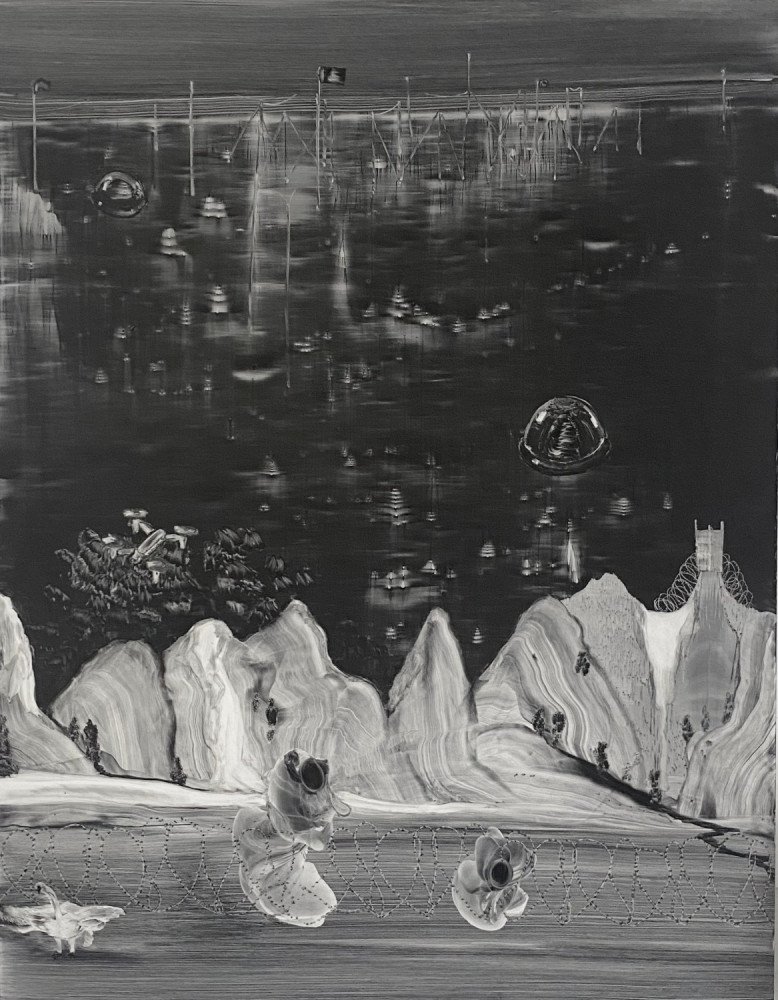
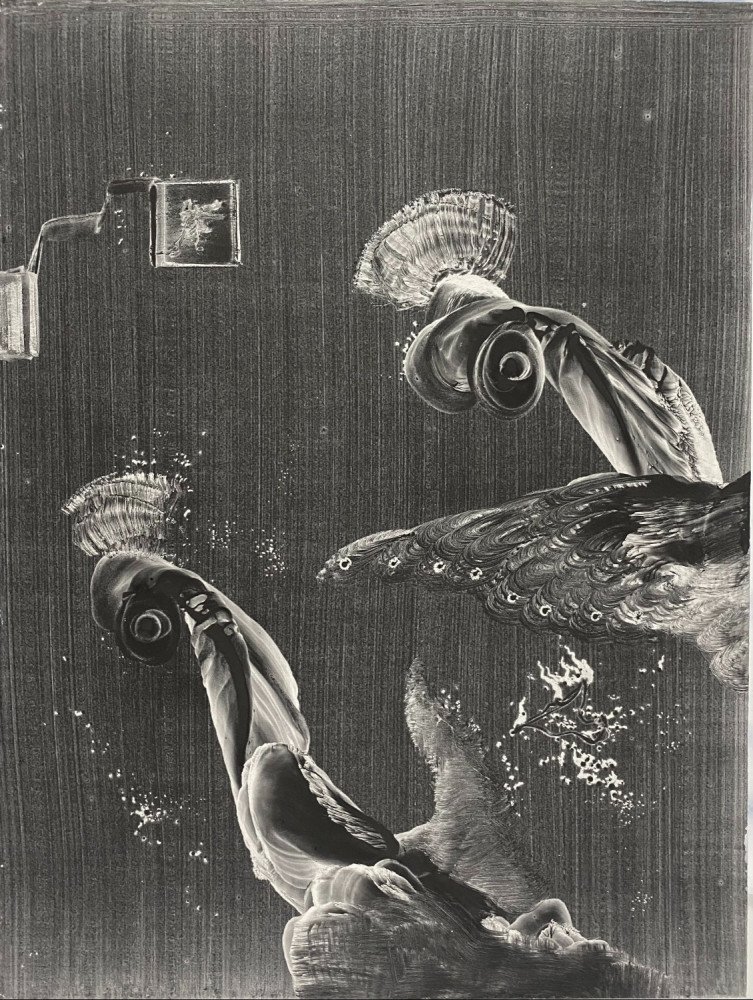
I have painted predominantly in black and white for more than twenty years, mixing my own medium by combining graphite powders with resins, oil and mineral spirits. The mixture is usually poured onto a resistant ground, worked with both traditional and unconventional implements, and removed to create the whites. The monochrome method facilitates improvisation and successive revision during the making, and yields a surface that retains immediacy.
This group of works responds to the spatial organisation of Persian miniature painting, a tradition I often return to, due to its ability to synthesise aspects of eastern painting, (predominantly Chinese and Mughal but also indigenous painting from Indian regions) with the influence of the late Renaissance, hence its tropes and narratives offer a compelling hybridity. The tradition tends to employ an elevated view that causes a flattening and ‘stacking’ of the middle ground, thereby allowing the viewer an advantageous perspective on the narrative. As the miniature was a private form of painting, (often concealed and carried in book format) it was common for it to contain figures, even though they were outlawed in the broader Islamic tradition. This humanist intimacy often gives it a confessional tone, concerned with the interplay of the domestic and the metaphysical.
Ancient Persia occupied an area which is now mainly Iran, a region which over the last century has again become a crucible (economic, political, and military) for the conflicting desires and interests of western and eastern ideologies. My reference to the miniature, reformulated and transposed by the monochromatic technique, wrestles with this complex baggage even when the subject matter is more playful, the tradition’s decorative aspects underscored by a sense of fragility and unease.